If you are a reality TV fan, you have definitely watched Catfish before.
It’s easy to sit on our couches and think, how could anyone really fall for this nonsense? But now we’re doing our own version of it. People are presenting AI-generated thoughts and words as their own, something some have started calling Claudefishing.
I pride myself on having a good eye for spotting AI-generated content, and there have been some cringe-worthy AI tells that I have been noticing recently. Some include:
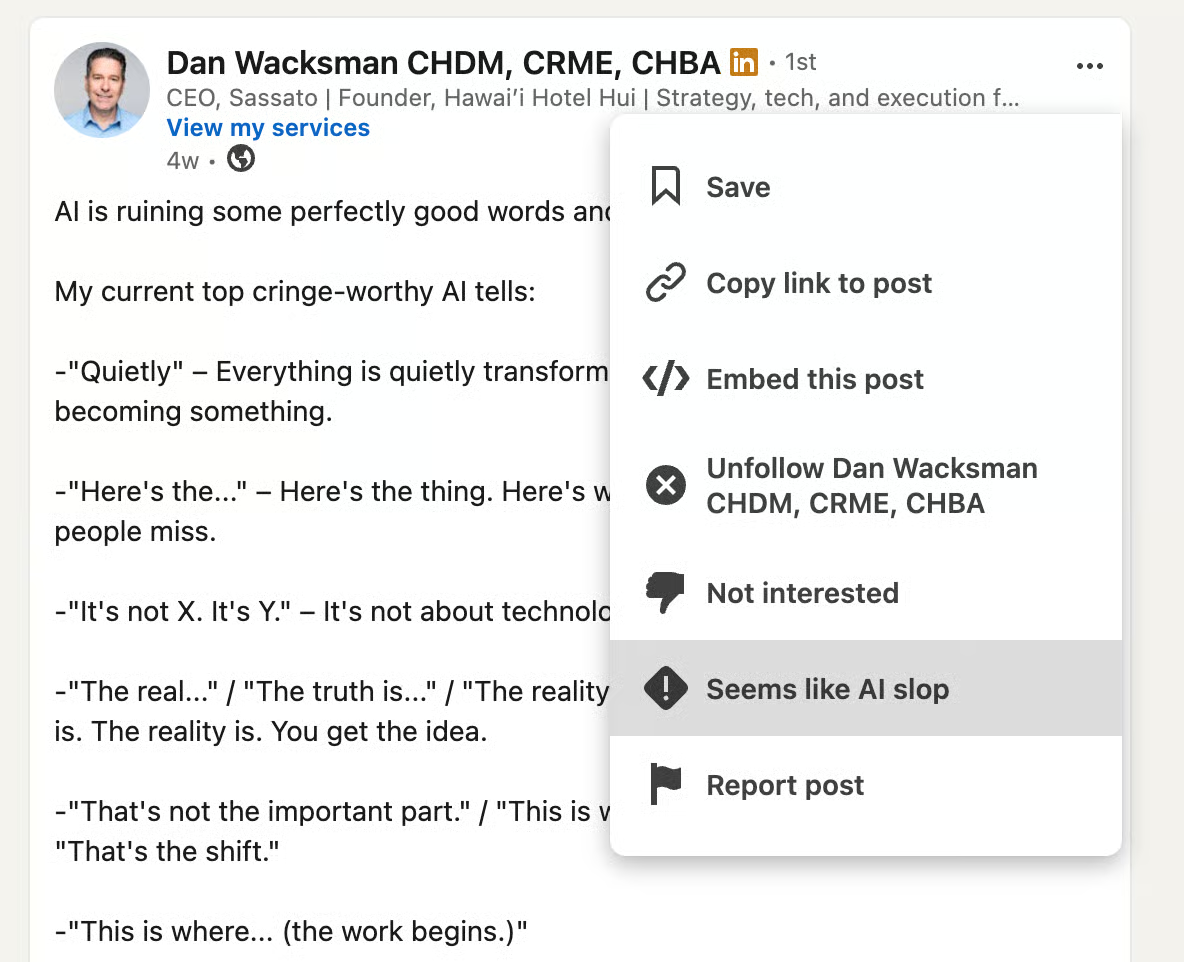
- “Quietly” – Everything is quietly transforming, quietly reshaping, or quietly becoming something.
- “Here’s the…” – Here’s the thing. Here’s what I learned. Here’s what most people miss.
- “It’s not X. It’s Y.” – It’s not about technology. It’s about transformation.
- “That’s not the important part.” / “This is what matters.” / “That’s the shift.”
- And so many more…
When I saw an article from Substack CEO Chris Best, criticizing the AI slop cesspool that LinkedIn has become recently, it caught my attention. The article announced a partnership with Pangram, which would allow readers on Substack to scan text and be given an estimate of what percentage was written by a human or with AI.
As an avid LinkedIn user, I can attest that there have been egregious examples of AI slop recently. And it appears LinkedIn is listening.
Nine days after the Substack post, LinkedIn unveiled a new feature: “Seems like AI slop” as a feedback option on posts and comments. LinkedIn’s own help page says the button doesn’t flag a policy violation or trigger a report. It just helps LinkedIn understand what members consider low-value content.
And before anyone calls me a hypocrite, I use AI a lot! The trick is using it to help you ideate and create great content, not to replace you with a slop version of you.